
AVatar: fire and (blue
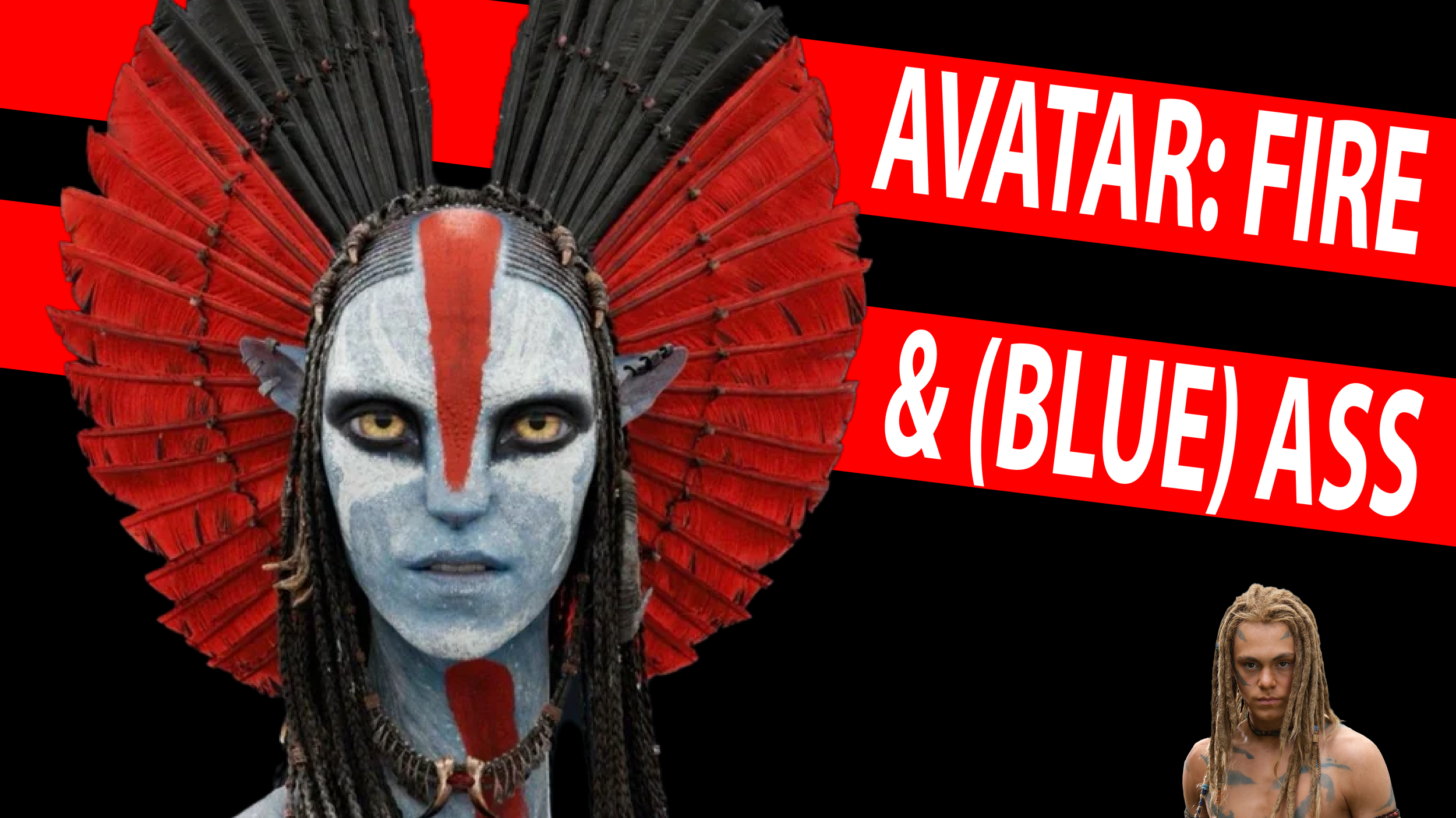
Last Thursday, I filed into my city’s local AMC IMAX theater, along with numerous other folks, anxious to see the latest installment of James Cameron’s growing Avatar franchise. And I gotta say, it’s really some unreal stuff. Absolutely bonkers filmmaking.
In many ways, it is a retread of the previous film, Avatar: The Way of Water, which is itself a more nautical retread of the original Avatar. Despite the subtitle Fire and Ash following The Way of Water evoking a classical elemental theme kinda like that other Avatar, you likely won’t be surprised to know that Cameron’s obsession with water, robotics, and sinking ships still completely dominates the screen here; the ratio of fire and ash to sea water is close to zero yet again. We get one scene set in the volcanic home of the Mangkwan (i.e. evil fire Na’vi), and besides shit getting blown up in spectacular fight scenes as usual, that’s really all the fire and ash there is to be had.
If the original film melded the U.S. invasion of Iraq with a kind of Native American romanticism, then Fire and Ash takes both analogues a step further: this time, the not-so-subtle American imperial stand-in of the “Resources Development Administration” takes the classic fed approach of arming one group of Na’vi to kill another, which is an essential step in U.S. foreign policy that guarantees that we will always have a new group of well-trained, reasonably vengeful religious nutjob insurgents to provide the Pentagon with next generation’s excuse for prolonging the forever war. The Mujahideen begets the Safari Club begets the Iran-Contra affair begets al-Qaeda begets the Al-Nusra Front begets ISIS, which will inevitably beget whatever group of Palestinian children / genocide victims who will one day grow up to inevitably attempt to pull off the next big attack on the West that will justify more forever war. It’s not a bug, its a feature of the world engineered last century, and we’re all living in it.
Furthermore, whatever Na’vi romanticism the previous two films may have promoted, here we’re shown for the first time that Na’vi, too, are fully capable of war crimes in tribe-versus-tribe combat, in a way that feels distinctly different when compared to the previous films, where different tribes held a kind of cautious respect for one another. It’s akin to the kind of liberal romanticism aimed at Native Americans, when no, even before whitey came along, they had their own problems and wars, just like any other group of people. Just like in this film, though, the addition of guns definitely made the pre-existing tribal wars much worse. Remember the end of the first Avatar where they send word out to other tribes to pull off that film’s last big battle? Yeah, Oona Chaplain’s Varang is difficult to imagine existing in such a world, but I suppose Pandora is a very big place.
Despite largely being a retread of the second film with the added angle of a Na’vi tribe conspiring with human space marines, there’s also something about this film that struck me as both more Biblical in the magnification of the second film’s themes, and also more perverse. There’s a scene in this that is essentially Cameron’s furry space people recreation of the Biblical story of the Binding of Isaac, which you could feel make much of the audience shift uncomfortably in their seats. There’s a scene during the climactic battle where Sigourney Weaver’s teenage furry she-Jesus character Kiri essentially recreates Moses’ miracle during the Battle of Rephidim (including the detail that she needs two allies to hold her hands in order to succeed in sustaining God’s favor), but with tentacles.
Speaking of Kiri, this film definitively establishes that she is a clone of Weaver’s original character (Dr. Grace Augustine), whereas I was previously under the impression that she was the same character reincarnated. It also emphasizes the virgin birth aspect of her origin, and her arc in this film felt very similar to the other billion-dollar space Jesus film of the 2020s thus far.
The film tackles the Na’vi religion with greater depth than before, as Kiri performs miracles of varying scope by connecting herself to the goddess Eywa (whom we get a glimpse of here, and it’s pretty dope). Faith in the Na’vi religion is more realistically portrayed by Zoe Saldaña’s Neytiri, who starts off the film by mourning the loss of her oldest son with series hero Jake Sully, wearing a veil and claiming that her faith is the only thing she has left following the scarring battles of the previous two films. Jake retorts that she still has her family, in a moment that kicks off the series ongoing theme of family as introduced in the previous film. Neytiri also holds a grudge against the “sky people” for obvious reasons, though things get a lot more awkward when everyone’s favorite white boy with dreads gets involved. James Cameron, as a deeply autistic white man, is uniquely ill-equipped to tackle the greater themes of race and religion while simultaneously delivering his third long-ass epic about tall blue cat people, but he hits a kind of lowest-common denominator with these themes that’s sure to crowdplease.
Speaking of white boys with dreads, Spider is probably the worst aspect of the film in many ways; Jack Champion’s performance leaves much to be desired, but I also feel for him considering what he’s up against. He already sticks out as a sore thumb as the only “pink-ass” we see for a majority of the runtime (besides the mostly-returning cast of military figures and capitalists seeking to colonize Pandora). His lines are woefully off-base, particularly when he refers to the RDA goons as “buttholes” near the end of the film, which struck me as incredibly at odds with the alien scenes of whale corpses and capsized boat-laden maritime warfare going on in that moment.
In this film, Spider singlehandedly becomes the most valuable human being in the universe, and yet, his development, and especially his relationship with his two Na’vi fathers (Jake Sully the adoptive, Miles Quaritch the formerly-biological), feels barely any different than it did in the last film. At the risk of mild spoilers for anyone bothering to read this far, I think that his arc of the film was disappointing in part due to the reduction in stakes; you’ve got Spider and his two blue dads who hate each other venturing through the forest together on an adventure, despite one of them being the Na’vi’s white savior and the other being their chief inflictor of war crimes.
The anti-military bent of these films is kind of fascinating to witness yet again, sitting in an IMAX in the real-life imperial core, as it were. And this go-around, as dudes draped in camo met end after grisly end wreathed in flame or drowning in the Pandoran ocean assaulted my eyes, a realization began to dawn on me: do people like these movies because they relate to the humorously-evil money-grubbing military? Cameron’s surely trying to strike a sudden comparison, what with the flashy future iPhones pulled out by the denizens of the ever-expanding human colony on Pandora, which looked a lot like Midgar from Final Fantasy 7. But more than that, I think that the only times I heard the audience react to anything – besides an occasional “damn” or gasp during scenes like Neytiri’s anti-sky people moments – was laughter following Quaritch’s quips. And there were a lot of quips, and there were a lot of laughs. It’s obvious to me that at this point, Quaritch is the most likeable character in the series for general audiences (or, at least, the most likeable character that doesn’t also serve as nerd goon fuel), which I feel is kind of a major problem for this series going forward, even if all signs are pointing to some sort of redemption arc.
It’s not hard to see why, since our hero Mr. Sully is pretty wooden in this. Not that he was ever particularly interesting, and I get that it’s tough to be likable when you’re staving off the destruction of your people, but c’mon. He’s so bland. It’s also kind of nuts how much he’s willing to risk it all to make Quaritch see the light, but I guess it makes sense that you’d seek some non-lethal options when facing the prospect of an unstoppable, respawning fascist who hates you.
Will this movie make another $2 billion? Maybe, but I kind of have doubts. These movies definitely evoke a kind of mass psychosis in general audiences that is psychically flushed from the system as soon as the 3D glasses come off. I think that The Way of Water benefitted massively from the decade-long hype of being the first Avatar sequel; with this additional sequel, relatively few things have changed, and the proximity to the last film in both content and relative release timing could pose some issues.
I also thought that the content of this one may pose a threat to its performance numbers. It’s definitely darker and edgier than previous films. We got a step-sibling kiss scene, a scene of a kid almost blowing their brains out with a big-ass rifle, and a sequence of Quaritch being drugged by Varang as a kind of loyalty test, where he proceeds to trip out in what is definitely the most psychedelic sequence in a top-grossing film, bar none. Super freaky to see that in IMAX with them 3D glasses on is all I’m saying. But I could be wrong; them naked blue asses make money, after all. It’s been proven before, and likely will again.
Other notes from this screening: they showed an 8-minute preview of Christopher Nolan’s Odyssey movie before this, and even though I hate the washed-out look of his movies more than I don’t, but it is admittedly nice to see some muscley dudes on-screen in the style of those old peplum films, of which there’s much to love.
They also had a trailer for some Star Wars slop that assaulted me with imagery of Baby Yoda in the movie theater, a supposed safe space from Disney+ cancer, but I guess not anymore now that streaming services are going to suck the last bit of dignity right out of theaters.
They also had a teaser for whatever the next Avengers movie is going to be, consisting solely of a shot or two of Chris Evans and promising that “[White] Captain America will return” in about a year’s time in that film, which was so bizarre to me. All I heard was cha-ching, baby.